| CRICOS CODE | 118000J |
|---|---|
| COURSE DURATION | 32 weeks (include 6 weeks holiday) |
| TUITION FEE | $8,000 |
| NON-TUITION FEE | $1,500 |
Graduates of this course may pursue roles such as:
Automotive Diagnostic Technician
Automotive Master Technician
Automotive Workshop Manager
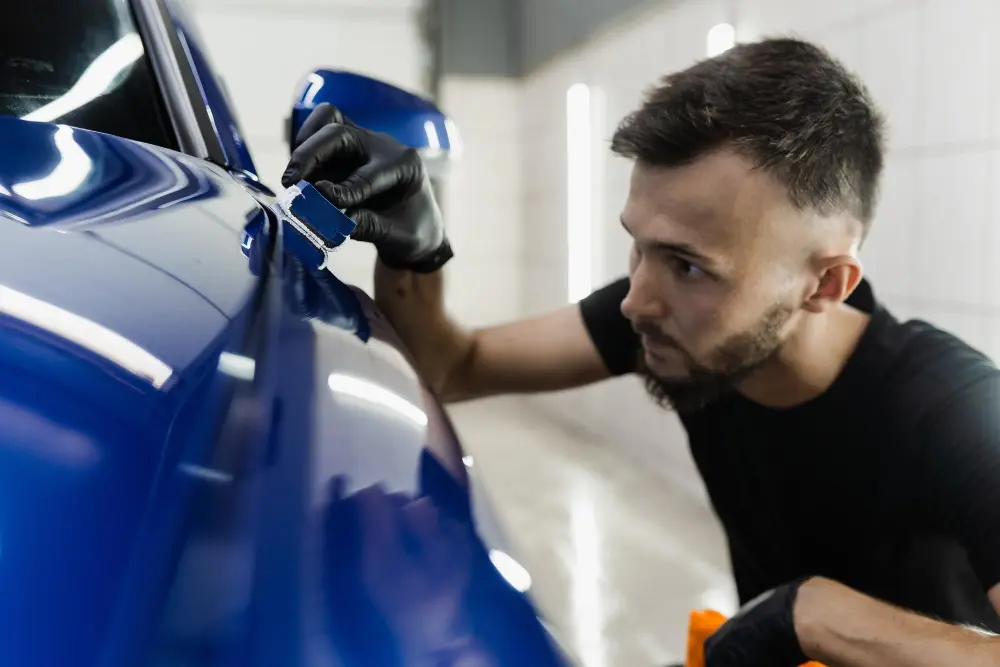
Building on trade-level skills, this qualification prepares you for supervisory and team leadership roles in the automotive body repair and refinishing sector. You will develop advanced technical skills alongside the knowledge to lead a team, manage workshop operations, liaise with customers and insurers, and maintain quality and workplace standards. Delivery combines classroom instruction with hands-on workshop practice. This qualification is suited to experienced body repair technicians looking to step into a senior or management role, and provides a pathway to the Diploma of Automotive Management.
Face to Face delivery
The course is expected to be completed in 32 weeks, 26 weeks delivery and 6 weeks of term breaks.
Level 5, 255 William Street Melbourne, Victoria 3000, Australia
Practical training and assessment are conducted at approved industry workplaces, simulated environments, and training venues arranged by Brighton Institute of Technology
To be awarded this qualification, competency must be demonstrated in 10 units of competency, consisting of:
3 core units
7 Elective Units (selected to meet packaging rules)
After completing AUR40720 Certificate IV in Automotive Body Repair Technology students can
enter in to AUR50216 - Diploma of Automotive Technology or AUR50116 - Diploma of Automotive
Management.
No licensing, legislative or certification requirements apply to this qualification at the
time of publication.
Source:
https://training.gov.au/training/details/AUR40720/qualdetails
Written Questions — Short answer questions covering advanced repair and refinishing techniques, estimating, insurance processes, and leadership responsibilities
Oral Questions — Verbal questioning to confirm knowledge of quality standards, workplace supervision, and technical repair processes
Practical Demonstrations — Complex repair and refinishing tasks performed in the workshop to industry standard, observed and assessed by a trainer
Projects / Reports — Repair estimates, quality control reports, and workplace leadership scenario tasks
Role-Plays — Simulated workplace scenarios involving customer interaction, team briefing, and quality inspection
Logbook— Documented evidence of tasks completed throughout the course
Please contact BIT’s admissions or marketing department for information on our upcoming
intakes.
The information provided on this website is intended as a general guide for prospective
students. Students are encouraged to read all relevant documents, including the Student
Handbook, Course Brochures, Policies and Procedures, Schedule of Fees, and Written
Agreement, to ensure they fully understand the course requirements, entry requirements,
fees, refund conditions, support services, assessment requirements, and their rights and
obligations prior to enrolment
| AURAEA003 |
Monitor environmental and sustainability best practice in an automotive workplace |
|---|---|
| AURAMA005 |
Manage complex customer issues in an automotive workplace |
| AURANN011 |
Estimate and quote automotive body repairs |
| AURVNA005 |
Inspect quality of vehicle repair work |
| AURVTN132 |
Inspect vehicle damage and determine repair procedures |
| AURVTN135 |
Apply original equipment manufacturer repair procedures during vehicle repairs |
| AURTTK102 |
Use and maintain tools and equipment in an automotive workplace |
|---|---|
| AURAMA001 |
Work effectively with others in an automotive workplace |
| AURVNA003 |
Review vehicle repair quotations |
| AURVTA104 |
Inspect damaged vehicle systems and recommend repairs |
All international learners entering Brighton Institute of Technology must be over 18 years of age at the commencement of their course.
All international learners will undertake a pre-training review which aims to identify
their training needs through questions on previous education or training, relevance of
the courses to the learner and any relevant experience they may have. An interview
conducted by Brighton Institute enrolment officer will cover these areas and also to
identify any support needs and possible RPL opportunities.
Through the pre-training review the learner will demonstrate that they have the
necessary skills to successfully complete the course.
Candidates undertaking this course are expected to possess appropriate Language, Literacy, Numeracy and Digital (LLND) skills to successfully participate in training and assessment activities. This includes the ability to read and interpret learning and workplace materials, communicate effectively, complete written tasks and calculations, use digital devices and online systems, and undertake technology-based learning and assessment activities where required.
All learners are required to undertake a Language, Literacy, Numeracy and Digital (LLND) assessment prior to enrolment. Learners are expected to demonstrate the minimum ACSF levels identified for the course and its training and assessment requirements.
Where a learner does not meet the required LLND levels, the Institute may identify appropriate support strategies, refer the learner to additional support services or training, or recommend further study such as English Language Intensive Courses for Overseas Students (ELICOS) before enrolment or commencement in the course.
Those undertaking Certificate IV in Automotive Body Repair Technology must have completed one of the following automotive Certificate III qualifications or be able to demonstrate equivalent competency.
AUR32120 Certificate III in Automotive Body Repair Technology
AUR32220 Certificate III in Automotive Glazing Technology
AUR32320 Certificate III in Automotive and Marine Trimming Technology
AUR32420 Certificate III in Automotive Refinishing Technology
All learners enrolling into BIT programs must have basic computer skills. BIT courses may
require learners to make reports, do graphs and analyse data.
Learners who do not possess basic computing skills will be referred to a computer
training course.
Although BIT will provide access to computers with required resources during classroom hours however to work on assignments and tasks for self-study, all students are expected to have access to a laptop or computer with the Windows 10 operating system or higher at their own cost. Students must have an active email address for communication and be contactable by phone (mobile or landline) and by mail (postal address). All learners are expected to have access to MS office applications such as Microsoft Word and an email platform. This will be at the applicant’s own cost.
Learners must have their own safety boots and workshop uniform (workshop overalls) for use during practical sessions in the automotive workshop prior to starting their practical classes. BIT will provide workshop tools, and other PPE as required.
Automotive technology is a physically demanding course and occupation. Working as a mechanic means that you will be on your feet for long hours and will have to lift heavy parts and equipment. Manual handling injuries are the most common type of injury occurring in automotive workshops. The injuries occur from handling heavy or awkward objects, heavy lifting, and prolonged or sustained work in awkward postures. This course involves manual handling e.g. heavy lifting; moving parts and tires, etc. So prospective learners should be able to handle the physical work required for this course. In line with its access and equity policy, BIT will identify any such barriers presented by learners during the pre-training review before enrolment and will identify and provide required support and reasonable adjustment where possible.
International learners applying for this course either off-shore or on-shore will require:
Either a minimum IELTS test score of 6.0 or equivalent for direct entry into a VET course or IELTS 5.5 or its equivalent plus 14 weeks ELICOS to be taken before the main VET course. Or IELTS 5.0 or its equivalent plus 20 weeks ELICOS to be taken before the main VET course. Or Note: Results older than two years are not acceptable.
Provide evidence that they have studied in English for at least five years in Australia, Canada, New Zealand, Republic of Ireland, South Africa, United Kingdom, or United States
ORHave completed a Certificate IV, Diploma or Advanced Diploma level qualification in Australia or
Have completed any Certificate III or Certificate IV in EAL from the EAL framework (Victoria) or
Have completed a General English course to the intermediate level.
| English language test providers | Minimum test score | Minimum Test Score where combined with at least 14 weeks ELICOS | Minimum test score where combined with at least 20 weeks ELICOS |
|---|---|---|---|
| International English Language Testing System | 6.0 | 5.5 | 5.0 |
| Cambridge C1 Advanced test | 169, each component | 162 | 154 |
| TOEFL internet-based test | 64 | 46 | 35 |
| Pearson Test of English Academic | 50 | 42 | 36 |
*The test must have been taken no more than two years* before you apply to study at BIT. If an international student is exempt from providing evidence of their level of English proficiency at the time of applying for a student visa, they will be required to complete BIT’s English Proficiency test to ensure they have the required level of English to complete the VET qualification they are enrolling in.